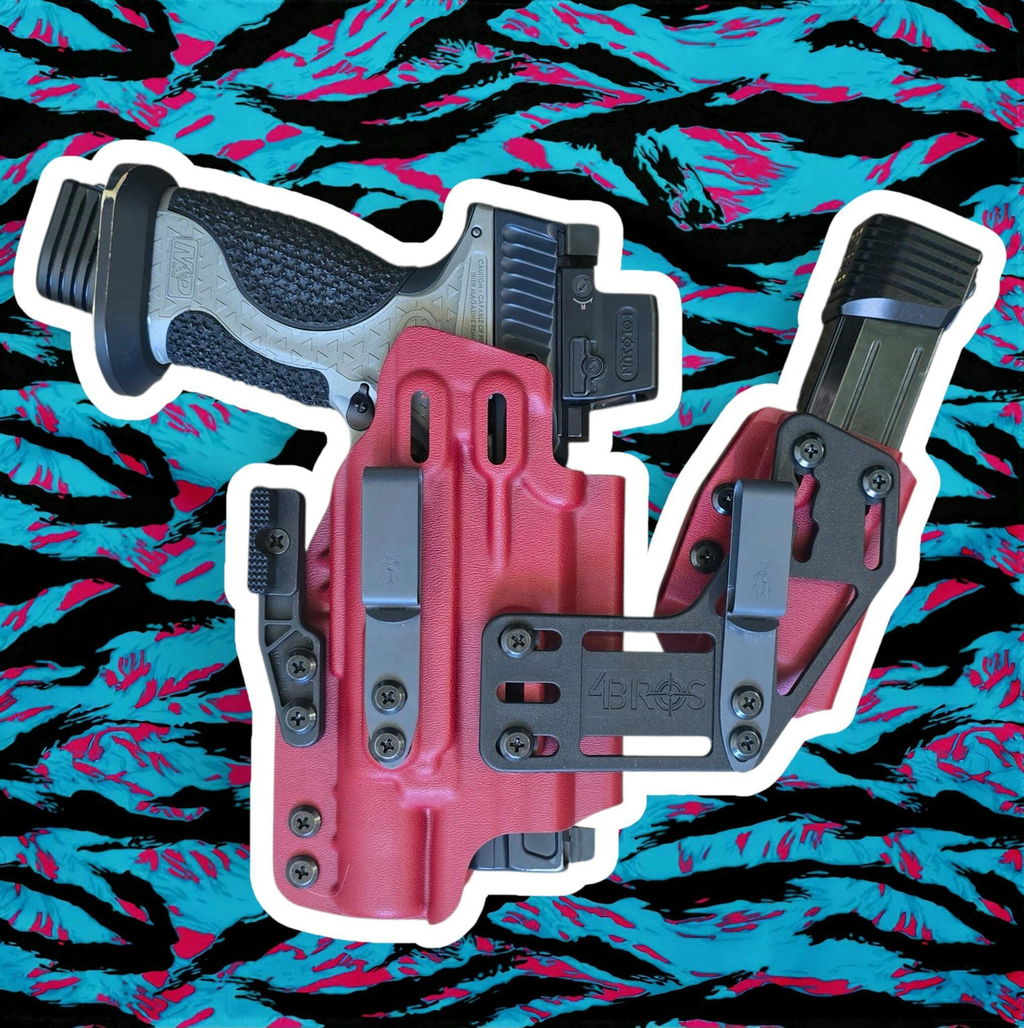

Magazine Carrier Positioning: The Math Behind Reload Speed
Your magazine placement isn't only about comfort or looks. The position of your magazine carriers directly impacts your reload speed in measurable ways. Understanding the biomechanics and geometry behind efficient reloading helps you set up your equipment for maximum performance.
Why Does Magazine Position Affect Reload Speed?
Every inch your support hand travels to reach a magazine adds time to your reload. The relationship between distance and time isn't linear either. Awkward positions that require additional body rotation or arm extension create even greater time penalties beyond simple distance.
Your support hand follows natural movement arcs dictated by your shoulder joint and arm length. Positioning magazines within these optimal arcs minimizes wasted motion. Placing them outside these arcs forces compensatory movements that slow you down and reduce consistency.

Distance And Time Relationship
Testing across multiple shooters shows consistent patterns. A magazine positioned 2 inches closer to your natural hand path typically saves 0.2-0.3 seconds per reload. This might seem minor, but those fractions compound quickly. In competition shooting or defensive scenarios where you perform multiple reloads, these seconds accumulate significantly.
Body Mechanics Matter
Your support hand naturally falls to specific positions when released from your firing grip. Fighting against these natural positions by reaching too far forward, backward, or to the side introduces inconsistency. Inconsistent draw strokes create varying reload times and increase the chance of fumbling magazines under stress.
What Is The Optimal Magazine Position On A Belt?
For belt-mounted magazine carriers, the fastest position places your primary magazine just forward of your support side hip bone. More specifically, position the front edge of your first carrier approximately 2-3 inches forward of your anterior superior iliac spine, the prominent bone at the front of your hip.
The Forward Placement Advantage
This forward positioning allows your support hand to drop naturally from the firing grip and land directly on the magazine without additional reaching or searching. Your hand travels the shortest possible distance while maintaining a natural movement path.
Testing shows this placement consistently delivers reload times 0.4-0.6 seconds faster than positioning magazines directly on the hip or behind the hip. The time savings come from reduced arm travel distance and eliminating the need to rotate your torso backward to reach the magazine.
Rake Angle Considerations
Beyond horizontal position, the angle or rake of your magazine carrier matters. Most shooters benefit from a slight forward rake of 10-15 degrees. This angle presents the magazine at an orientation that matches your hand's natural approach angle as it drops from the firing position.
A magazine sitting perfectly vertical requires more precise hand positioning to achieve a clean grip. The forward rake essentially pre-positions the magazine for your hand's arrival, allowing faster acquisition and more consistent indexing.

How Should You Position Multiple Magazine Carriers?
When running multiple magazine carriers on your belt, strategic sequencing maximizes efficiency throughout your entire loadout.
Primary Magazine Placement
Your first magazine should occupy that optimal position just forward of your support side hip. This is your "speed reload" magazine for when you absolutely need ammunition right now. Whether you're making up time in competition or responding to an immediate threat, this magazine gets accessed first and fastest.
Secondary Magazine Positioning
Place your second magazine carrier immediately behind your first, maintaining the same rake angle. Position it close enough that you can smoothly transition from the first pouch to the second without searching, but far enough that drawing from the first pouch doesn't disturb the second magazine.
Typically, 1-1.5 inches of spacing between carriers works well. This allows your hand to clearly differentiate between pouches while keeping both within your natural reach zone.
Working From Front To Back
Reload sequencing should progress from front to back along your belt. This pattern keeps your support hand moving in a consistent direction as you work through your ammunition supply. Your muscle memory develops one reliable movement pattern rather than requiring different reaches for different magazines.
What About Strong Side Magazine Carriers?
Some shooters carry magazines on their strong side belt, either as primary carriers or as backup to support side carriers. Strong side placement serves different purposes than support side positioning.
Backup Rather Than Primary
Strong side magazines function better as reserves than as primary reload sources. Reaching across your body with your support hand to access a strong side magazine is slower and more awkward than reaching to your support side. Testing shows strong side reloads typically run 0.8-1.2 seconds slower than support side reloads.
Administrative Reload Considerations
Strong side magazines work well for administrative reloads when you're not under time pressure. During training or practice, you might reload from your strong side to preserve your support side magazines for live fire exercises. In equipment balancing, strong side carriers help distribute weight more evenly around your belt.
Emergency Access
If your support hand becomes injured or disabled, strong side magazines provide an emergency option. While slow, you can access them with your strong hand if necessary, though this obviously requires dropping your firearm or performing a one-handed reload.
How Does Body Type Affect Magazine Positioning?
Individual body characteristics influence the optimal placement of magazines. What works for one shooter may need adjustment for another.
Height And Arm Length
Taller shooters with longer arms can often position magazines slightly further back without time penalty because their longer reach compensates for the additional distance. Shorter shooters benefit more from aggressive forward placement to minimize reach requirements.
Test your specific setup by timing reloads from different positions. If you can consistently pull sub-2-second reloads from a position, it's probably working for your body type.
Waist Size Variations
Larger waist measurements change the geometry of belt-mounted carriers. The same carrier position that sits on someone's front quarter panel might end up almost on their hip when worn by someone with a larger waist. Account for this by measuring from anatomical landmarks like your hip bone rather than using arbitrary positions.
Flexibility And Mobility
Shoulder mobility and flexibility affect your reach envelope. If you have restricted shoulder movement, you might need to position magazines more forward to accommodate your reduced range of motion. Regular mobility work can expand your effective reach zone and provide more flexibility in carrier positioning.
What Are The Best Magazine Carrier Designs For Speed?
Carrier design significantly impacts reload speed beyond just positioning.
Open Top Versus Flapped Designs
Open top carriers like those from 4Bros Holsters provide the fastest access. Your hand drops directly onto the magazine without needing to manipulate retention devices or open flaps. Testing shows open top carriers typically deliver reloads 0.3-0.5 seconds faster than flapped designs.
Kydex and polymer open top carriers maintain positive retention through friction fit while allowing immediate access. The rigid construction also provides consistent magazine presentation, helping your hand find the same grip every time.
Retention Systems
Retention should be strong enough to secure your magazines during athletic movement but light enough to allow smooth draws. Adjustable retention lets you dial in the perfect balance for your specific needs.
Over-retention forces you to pull harder, disrupting your draw stroke and potentially pulling your belt out of position. Under-retention risks losing magazines during movement. Test retention by running, jumping, and performing other dynamic movements to ensure magazines stay secure.
Consistent Magazine Indexing
Quality carriers position magazines at the same height and angle every time. This consistency helps your hand develop reliable muscle memory for magazine acquisition. Each draw stroke begins from the same starting point, improving your speed and reducing fumbles.
How Do You Test And Refine Your Magazine Setup?
Optimization requires systematic testing and honest evaluation of your performance.
Baseline Your Current Setup
Start by timing 10 reloads from your current magazine positions. Calculate your average time and note your consistency. Large variations between your fastest and slowest reloads indicate positioning or technique problems.
Make Incremental Changes
Adjust your primary magazine carrier position by one inch forward or backward. Run another 10 timed reloads. Compare your new average to your baseline. If you improved, consider making another small adjustment in the same direction. If you slowed down, return to your previous position and try adjusting the opposite direction.
Test Under Dynamic Conditions
Static standing reloads only tell part of the story. Test your magazine positions while moving, after running, and while transitioning between shooting positions. Your optimal setup should work across all these conditions, not just when you're fresh and standing still.
Find Your Perfect Magazine Setup
Magazine carrier positioning isn't one-size-fits-all, but understanding the principles behind efficient placement helps you develop a setup optimized for your body and shooting style. At 4Bros Holsters, we manufacture precision Kydex magazine carriers designed for fast access and reliable retention.
Our inside waistband and outside waistband magazine carriers use adjustable retention systems that let you fine-tune the draw resistance for your preference. The rigid Kydex construction maintains consistent magazine positioning and presentation, helping you develop the muscle memory that drives fast, reliable reloads.
Shop 4Bros Magazine Carriers
Explore our complete selection of magazine carriers for your firearm. Every carrier is proudly made in Logansport, Indiana and ships within 24-48 hours.
Whether you're competing, carrying concealed, or training seriously, the right magazine carrier in the right position makes a measurable difference in your performance. Let us help you dial in your setup for maximum speed and reliability.