

Streamlight TLR-8 vs TLR-7: Size Comparison and Holster Implications
Blog TeamIf you run a compact carry gun with a weapon light, you have probably looked at the Streamlight TLR-7 and TLR-8 families. On paper, they look almost identical. In practice, the added laser on the TLR-8 changes the footprint just enough that it matters a lot for holsters and concealment.
This guide walks through the real size differences, what that means for holster fit, and how to decide which light makes more sense for your setup.
Our TLR-7 vs TLR-8 Quick Overview
Streamlight TLR-7 (and TLR-7A)
- Compact, white-light only pistol light
- Rated at 500 lumens with a tight, usable beam for defensive distances
-
Uses a single CR123A battery (newer X / HL-X versions also support Streamlight’s SL-B9 rechargeable pack).
Available with original side switches (TLR-7) or improved rear paddles (TLR-7A)
Streamlight TLR-8 (and TLR-8A)
- Same basic light as the TLR-7, but with an integrated red or green laser under the bezel
-
Also 500 lumens with similar candela and beam distance
Modes for light only, laser only, or light + laser -
Uses the same CR123A battery, with newer X / HL-X models adding multi-fuel capability.
Functionally, the big difference is simple:
- TLR-7 = light only
- TLR-8 = light + laser
But the way Streamlight added that laser is what creates the size and holster issues.

Where the TLR-8 Gets Bigger
Both lights are built on the same core footprint. The laser housing on the TLR-8 adds height and a bit of weight.
Key takeaways:
- Same length and width. They take up similar rail space and slide length.
- TLR-8 is about 0.23 in taller. That extra height is the laser housing under the bezel.
- TLR-8 is slightly heavier. Roughly a quarter ounce more with the battery.
For most shooters, you will not feel that weight difference on the gun. The height change is what matters because holsters are molded around the full outline of the light, not just the top half.
What About TLR-7A / TLR-8A / X / HL-X Variants?
Over time, Streamlight expanded the line:
- TLR-7A and TLR-8A add improved rear paddle switches. Those versions are longer than the originals but keep the same width and relative height difference.
- TLR-7 X and TLR-8 X keep the compact footprint but add multi-fuel (CR123A or SL-B9 rechargeable) and updated electronics.
- HL-X and “sub” models push output to 1000 lumens and tweak dimensions for specific guns and rails (for example, the TLR-7 HL-X Sub is about 2.51 in long, 1.16 in wide, 1.24 in tall).
The important pattern:
- Inside each “7” family (TLR-7, 7A, 7 X, HL-X), the light-only profile stays lower.
-
Inside each “8” family (TLR-8, 8A, 8 X, HL-X), the light + laser profile stays taller because of the laser module.
So even with newer variants, the same holster logic still applies: a holster molded for a TLR-7 family light will not be the same as one molded for a TLR-8 family light.
Why Does The TLR-8 Not Fit in TLR-7 Holsters?
On a Kydex holster, the weapon light is usually a major part of the retention system. The light body and bezel sit in a molded channel that grabs the light in a specific place and depth.
With the older compact models:
- The TLR-7 shape is lower profile. The bottom of the light is fairly flat.
- The TLR-8 hangs lower because of the laser housing under the bezel.
That means:
- A TLR-8 will not fully seat in a TLR-7 holster. The taller laser housing hits Kydex that was molded for a lower profile light. You will often feel the light bottom out early or see the gun ride higher in the holster than it should. Retention points also do not line up where they were designed.
- If you force it, you risk poor retention or damage. Trying to “cram” a TLR-8 into a TLR-7 holster can flex the Kydex, change the clamping pressure, or partially expose the trigger guard. None of that is acceptable for a carry rig.
- The reverse is also a problem. Dropping a TLR-7 into a holster molded for a TLR-8 leaves extra space where the laser body would be. That can create slop, inconsistent lock-up, and an unpredictable draw stroke.
Holster molds are cut on tight tolerances. A few tenths of an inch of extra height is enough to make the difference between a safe, consistent holster and something that does not work the way it should.

How the Size Difference Shows up on the Gun
On carry pistols that are already small in the hand, even small changes matter.
- Concealment: The extra height of the TLR-8 adds a bit more bulk under the dust cover. Under a shirt or hoodie this can print differently than a TLR-7. It is not a night-and-day change, but it is there.
- Muzzle and holster length: Because the TLR-7 and TLR-8 share the same length on the original models, slide flush and rail fit are basically the same. The newer 7A / 8A and X / HL-X variants add length depending on the switch housing and head design. That is another reason you should always match holster to the exact light model, not just “TLR-7” or “TLR-8” in general.
- Draw stroke feel: With holsters that retain on the light body, the extra bulk of the TLR-8 can create a slightly stronger “click” into and out of retention. That is not a problem by itself, but it is something you will notice when you go back and forth between setups.
Do You Actually Need the Laser on a TLR-8?
This is the real choice between the two families.
What the TLR-8 laser gives you:
- A visible aiming reference that can be easier to pick up from awkward positions, around cover, or in unconventional shooting stances
- An adjustable zero so you can set the laser to a specific distance or point of impact
- Light only, laser only, or light + laser modes
What it costs you:
- Slightly more weight and more height under the frame
- A more complex control setup
- The need to manage two aiming systems (sights and laser) and keep the laser zeroed
- A different holster than your TLR-7 rig, even on the same gun
If you:
-
Already have a well-zeroed red dot
Do most of your practice with traditional sights or optics - Prefer the smallest possible package on the rail
then a TLR-7 or TLR-7 X / HL-X is usually the cleaner choice.
If you:
- Train regularly with a laser
- Want a backup aiming reference that is independent of your optic
- Work in low-light environments where a visible laser helps with unconventional shooting positions
then the TLR-8 family can earn its extra size.
4 Holster Implications
Here is the practical bottom line for holsters:
-
Match the holster to the exact light model.
TLR-7 vs TLR-7A vs TLR-7 X vs TLR-7 HL-X all have slightly different footprints. TLR-8 vs TLR-8A vs TLR-8 X vs TLR-8 HL-X are the same story.
-
Do not mix TLR-7 and TLR-8 holsters. Even if they “almost” fit, the retention and trigger coverage were not designed for that combination.
-
Pay attention to rail type and “sub” models. Streamlight builds dedicated subcompact versions (Glock, 1913, SIG P365, etc.), and each has its own mounting key and slight geometry change. Holsters for a full-size TLR-7 HL-X are not the same as holsters for a TLR-7 HL-X Sub.
- Retention should be on the light body, not just the slide. When retention is built around the light, your draw and feel stay consistent across guns that share that light. That is why a lot of modern carry holsters lock on to the light channel rather than the trigger guard alone.
If you change anything in the stack (like gun, light model, optic height, or even rail version), treat it as a new setup and confirm holster fit from scratch.
Choosing Between TLR-8 and TLR-7 for Concealed Carry
A simple way to frame it:
Go TLR-7 family if:
- Maximum concealment and minimal bulk are your priority
- You want a straightforward, white-light only tool with less to manage
-
You already rely on iron sights or a pistol red dot for aiming
Go TLR-8 family if:
- You want light plus a visible laser in one unit
- You train enough to actually integrate the laser into your shooting
-
You are willing to accept a slightly taller profile and commit to a dedicated holster
Both lines are well proven. The real decision is whether you will truly use the laser enough to justify the extra height and the need for a TLR-8 specific holster.
Which Streamlight Is Right for You?
On a spec sheet, the Streamlight TLR-8 and TLR-7 look very similar. Same output, same basic length, same mounting style. lyssos.com+2Streamlight.nl+2
Once you add holsters into the picture, the story changes. The TLR-8 is slightly taller and heavier because of the integrated laser, and that small dimensional change means:
-
You cannot safely swap TLR-8 into a TLR-7 holster
You cannot rely on a TLR-8 holster to give proper retention with a TLR-7 - You need to pick a holster that is molded for your exact light and pistol combination
If you decide to run either light on a carry gun, start by choosing the light that fits how you actually shoot. Then select a holster that is built around that exact model, confirm fit with the gun unloaded, and do your dry-fire work before the rig ever leaves the house.
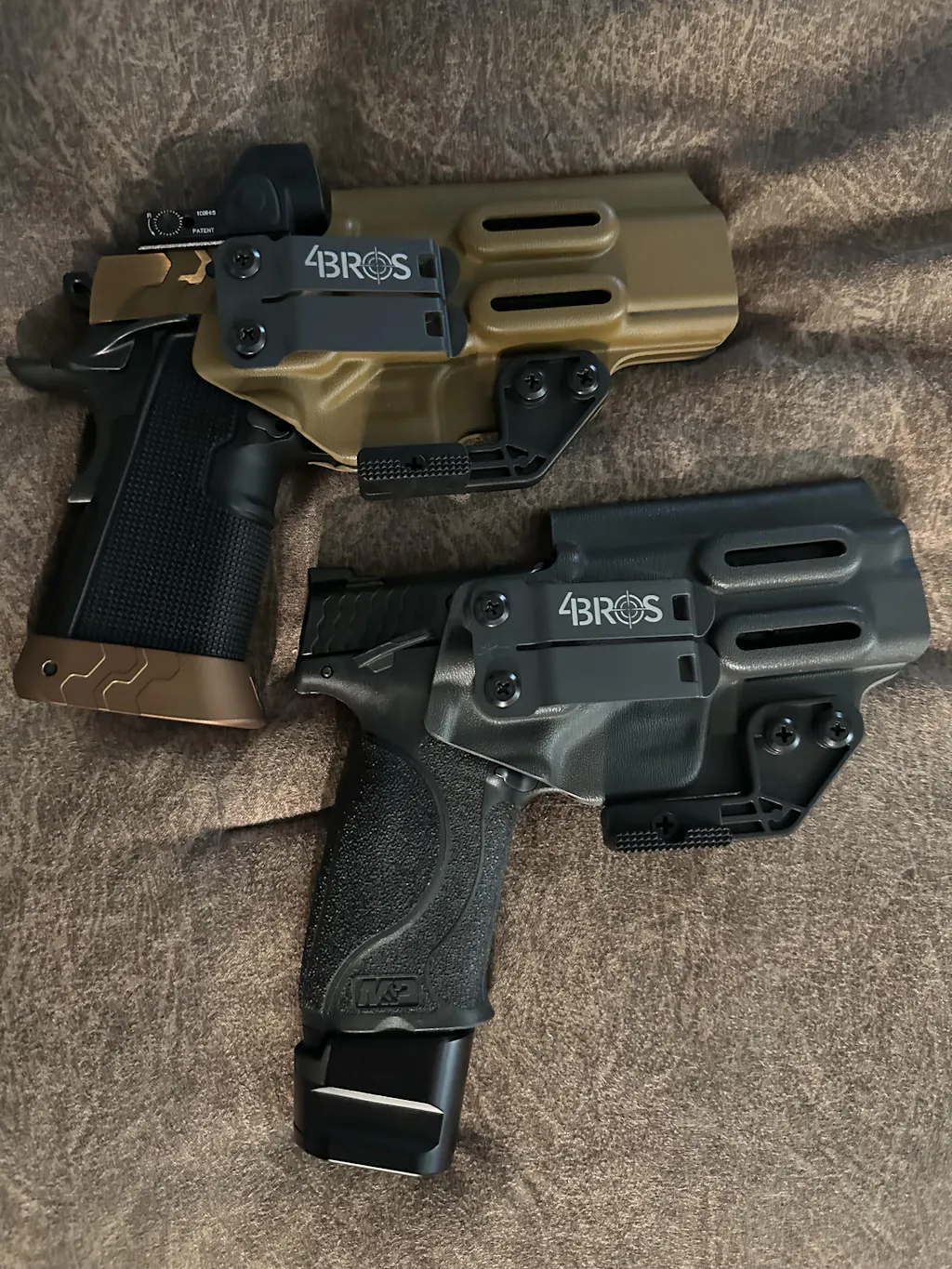
Whether you’re rocking a TLR-7 or TLR-8, we’ve got your fit dialed in. Every 4Bros holster is tested on the actual pistol and light for secure retention and everyday comfort.